Game-Based Language Learning
A seminar on learning English through computer games
Welcome to Judy’s Seminar on Game-Based English Learning offered at Hosei University!
In this seminar, students immerse themselves in English language learning through the exciting world of computer games. With the teacher’s guidance, students will engage in gameplay, participate in learning activities, and complete assignments designed to boost both motivation and effective learning outcomes. Throughout the seminar, students will have the chance to expand their vocabulary and develop their reading, writing, listening, and speaking skills.
Beyond language acquisition, this seminar will also help students cultivate essential skills such as communication, collaboration, creativity, reasoning, and problem-solving. The seminar is open to learners of all proficiency levels, and the difficulty will be adjusted to meet individual needs, ensuring an inclusive and supportive learning environment.
Below is a list of games planned for the seminar, together with showcase of coursework from the students.
Game titles, logos, and promotional images on this page are trademarks and copyrights of their respective owners. Store header images are sourced from the games’ Steam store pages and are used here for identification and commentary purposes only. This is a non-commercial site and is not affiliated with or endorsed by Valve or any game publisher. Rights holders may contact me for corrections or removal requests.
To the Moon

To the Moon is a story-driven indie adventure game developed by Freebird Games. The game follows two doctors who travel through a dying man’s memories to fulfill his final wish—to go to the moon. Rather than focusing on gameplay mechanics, the game emphasizes emotional storytelling, character development, and narrative exploration through dialogue and memory sequences.
Potential for Language Learning
To the Moon offers rich exposure to narrative English, including emotional expression, dialogue, and descriptive storytelling. The game features a large amount of written text, making it especially useful for developing reading comprehension and understanding nuanced language related to relationships, memory, and emotions.
Suggested Learning Activities
- Students write reflective journals summarizing key story events and emotional turning points.
- Group discussions analyzing characters’ motivations and relationships.
- Creative writing tasks where students imagine alternative endings or missing scenes.
- Presentations analyzing themes such as memory, regret, and fulfillment.
Overall Ratings (full score=10)
- Game Difficulty: 2
- Engagement: 6
- Text Genre: Narrative, Drama
- Text Volume: 9
- Vocabulary Difficulty: 7
- Listening Input: None
- Required English proficiency: Low to Intermediate
- Helpfulness for English Learning: 7
Coursework Showcase
Presentation
Student writing
Should the government ban memory alteration?
In the game “To the Moon”, doctors change a John’s memories. I think this idea is very interesting. However, should memory alteration be allowed in the real world? I think the government should not allow memory alteration and should ban it. There are three reasons for this.
First, wealthy people would be able to buy a perfect life with money. If memory alteration is available, rich people could erase bad memories and create happier ones. On the other hand, poor people would not be able to do the same. This could increase inequality in society gradually.
Second, there is a possibility that governments or corporations could manipulate people’s memories. If governments use memory alteration, it could lead to a dictatorship allowing them to control what people think and remember. If corporations use memory alteration, they could manipulate people’s decisions and make large profits for their benefit.
Third, people may not be able to truly consent to having their memories rewritten. Memories are an important part of a person’s identity. If someone’s memories changed, they may become a different person in some ways. Therefore, it is difficult to know whether a person can fully understand the consequences of memory alteration before agreeing to it. Personally, I think bad memories are an important part of who we are. It is a necessary experience in life. Therefore, memory alteration should not be freely allowed.
In conclusion, the government should ban memory alteration because rich people could buy a perfect life, governments or corporations could manipulate people’s memories, and true consent may be impossible when memories are rewritten. For these reasons, the government should ban memory alteration.
Death and Taxes

Death and Taxes is a narrative simulation game where players take on the role of a grim reaper working in an office setting. Players must decide who lives and who dies based on given criteria, while interacting with their supervisor and uncovering deeper philosophical themes about fate, morality, and responsibility.
Potential for Language Learning
This game provides strong exposure to formal and semi-formal English, especially in workplace communication and ethical reasoning. The text-heavy interface encourages reading comprehension, while the moral dilemmas promote critical thinking and discussion using abstract vocabulary.
Suggested Learning Activities
- Students debate ethical decisions made during gameplay.
- Writing assignments explaining their reasoning for life-and-death choices.
Overall Ratings
- Game Difficulty: 4
- Engagement: 8
- Text Genre: Philosophy, Workplace
- Text Volume: 7
- Vocabulary Difficulty: 8 (many rare but interesting words)
- Listening Input: Yes (occasional conversation with the Boss)
- Required English proficiency: Intermediate
- Helpfulness for English Learning: 8
Coursework Showcase
Decision letters
Who should die?
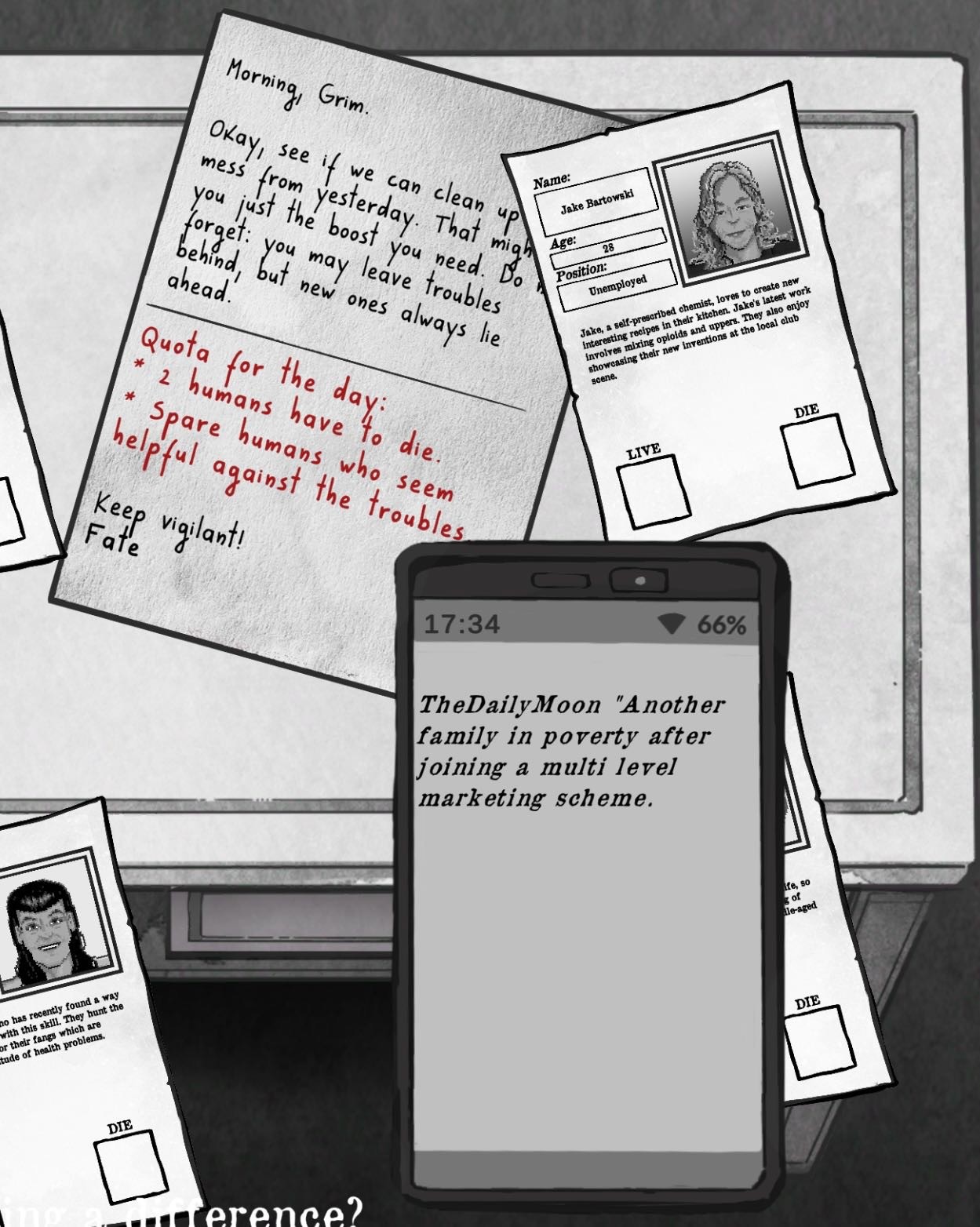
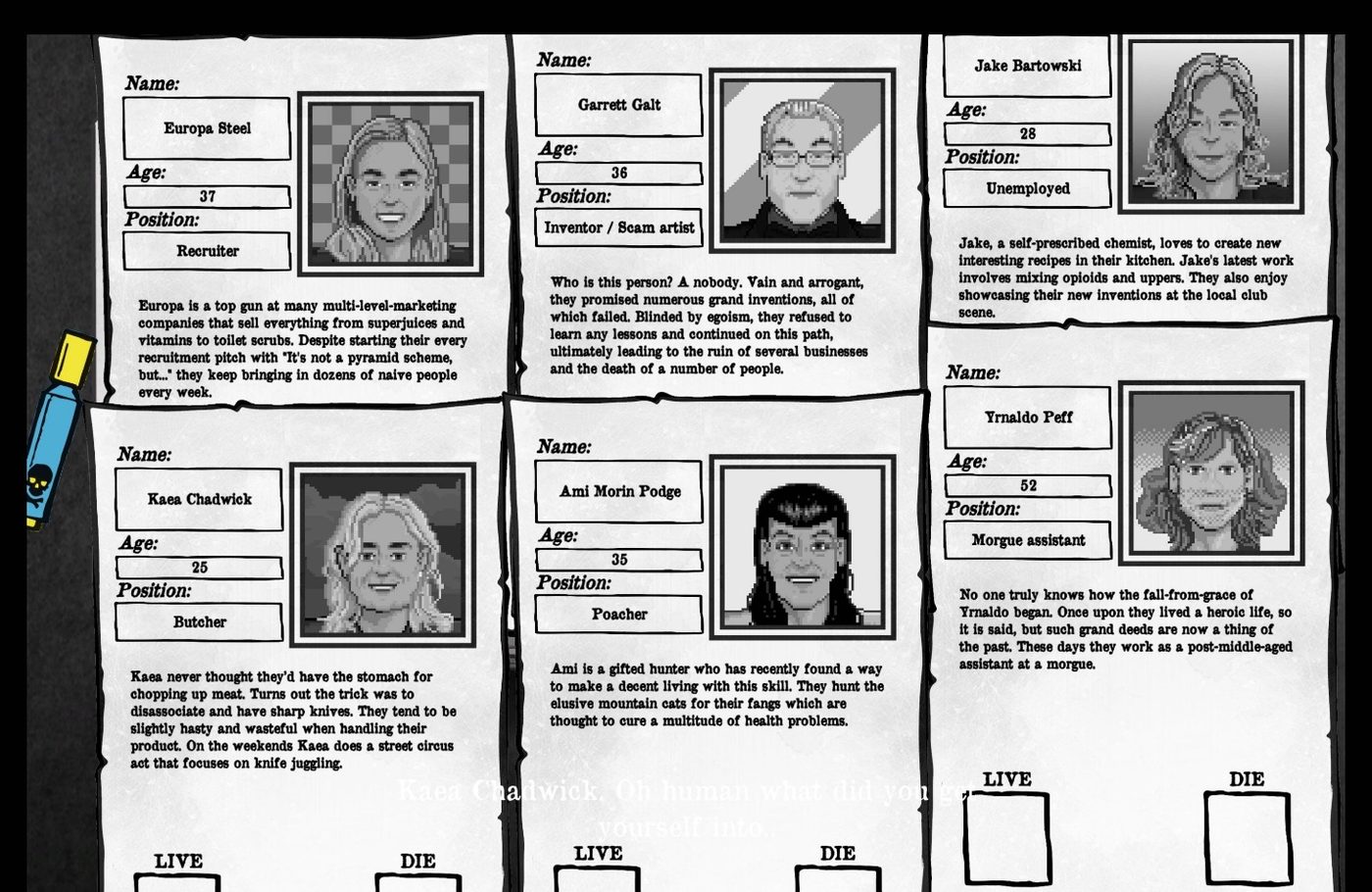
Instructions: Two people need to die. Spare humans who seem helpful against the trouble.
Marked to die: Europa Steel and Garrett Galt
There is a news about family in poverty after join a multi level maketing scheme, so i chose Europa. Although she is doing well on her job, it would make some naive people become poor. What she doing seems to contribute to the problem.
I found it interesting that some people’s job are very unusual shuch as poacher and morgue assistant. Then, I had difficulty deciding who to die between Garrett and Ami Morin Podge. Aim’s job is a hunter who hunt the elusive animals, which is harmful to the environment. However, the profile also mentions that the fangs can cure many health problems. Therefore, I chose Garrett to die because he is a bad inventor and scam artist. What him doing is leading to the ruin of several businesses and the death of a number of people. He doesn’t seem helpful against the trouble either, so I chose him to die.
Three plants need to die
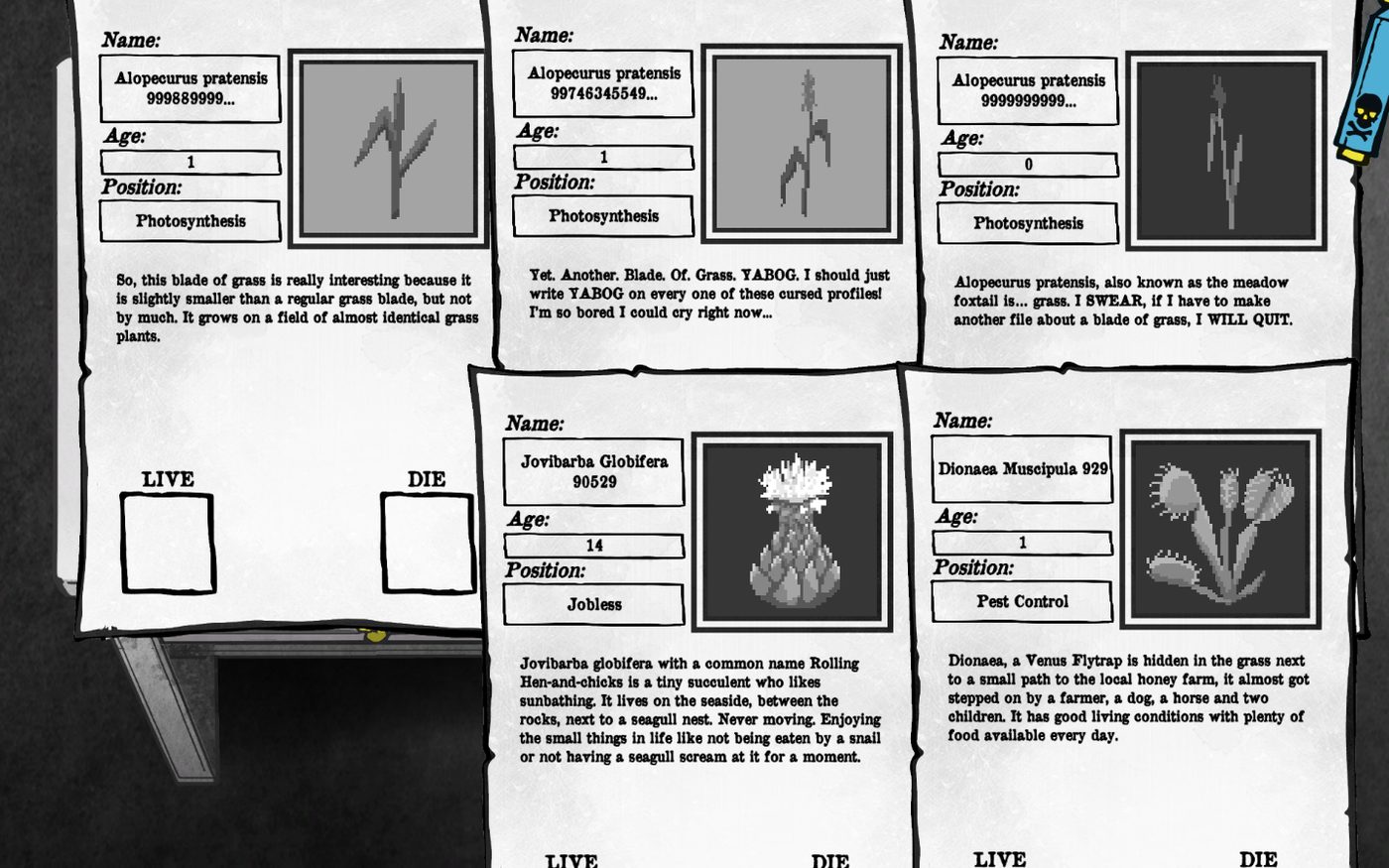
Instructions: 3 plants need to die.
Marked to die: Alopecurus pratensis 99746345549…, Alopecurus pratensis 999889999…, Alopecurus pratensis 9999999999…
I killed? mowed? the weeds that weren't interesting enough to be mentioned in the report.
Student presentations
Presentation 1
Presentation 2
The Sims 4

The Sims 4 is a life simulation game developed by Maxis and published by Electronic Arts. In this game, players create and control virtual characters, known as “Sims,” by managing their needs, desires, relationships, and careers. Players can design their homes, guide Sims through different life stages, and create stories through a wide variety of interactions, including socializing, working, and skill-building. Expansion packs introduce additional content, allowing players to explore various themes such as seasons, holidays, and hobbies.
Potential for Language Learning
The Sims 4 offers an excellent opportunity for language learners to engage with practical, everyday English. The game provides numerous opportunities to practice vocabulary related to daily life, such as food, home, work, relationships, and social interactions. Text input comes in the form of in-game notifications, task descriptions, and interactions.
Suggested Learning Activities
- Students can keep a journal documenting their Sims’ experiences, including the language related to everyday activities such as cooking, cleaning, and working.
- Role-playing activities based on Sims scenarios, such as job interviews or social events, can further enhance conversational skills.
- Presentations of gameplay recordings are also desirable.
Overall Ratings
- Game Difficulty: 3
- Engagement: 9
- Text Genre: Daily Life
- Text Volume: 7
- Vocabulary Difficulty: 6
- Listening Input: None
- Requirement of English proficiency: Low to Intermediate
- Helpfulness for English Learning: 7
Coursework Showcase
Student writing
Introduction to the Household

The one of the center is Hotdog Man. He is the father of his daughter, which one of the left. He is childish, clumsy and goofball man however his aspiration is to being nerdy. He likes to listen to Kids Radio Music.
The one of the right is Hotdog Women. She is the mother. She is erratic, goofball and glutton women and her aspiration is to being master chef. She likes to cook.
The one of the left is Kuso Gaki. She is the daughter of parents that explained previously, and she is goofball and vegetarian. Due to being vegetarian, she cannot eat hotdogs despite her looks. Her aspiration is to being angling ace and she likes fishing. However, she is vegetarian.
Beyond the titles above, students are welcome to propose other games they find suitable for language learning. The games below are additional options worth exploring, with notes on the skills they support.
Detroit: Become Human

Detroit: Become Human is an interactive narrative adventure game developed by Quantic Dream. Set in a futuristic Detroit where androids are integrated into society, the game follows the lives of three androids who experience complex human emotions and face difficult decisions that affect their fate, as well as the fate of humanity. The game heavily relies on branching storylines where player choices dramatically alter the outcome of the plot.
Potential for Language Learning
Detroit: Become Human provides an immersive opportunity for language learners due to its heavy reliance on dialogue, character interaction, and decision-making. The game offers both written and spoken input, with many scenes involving conversations and decision-making processes. The vocabulary spans daily life, crime, and philosophical themes related to ethics and identity, making it ideal for learners looking to expand their conversational and thematic English.
Suggested Learning Activities
- Students engage in debates on ethical dilemmas in the game (e.g., android rights), practicing persuasive language and reasoning.
- Role-playing scenes from the game, with students improvising dialogue based on character perspectives to enhance conversational skills.
- Writing alternative endings to explore narrative writing and critical thinking.
- Character analysis essays focusing on motivations, personality traits, and growth of key characters to practice descriptive writing.
- Listening exercises using dialogue from the game to analyze tone, emotion, and persuasive arguments.
- Students write and deliver persuasive speeches inspired by Markus’s in-game speeches, practicing public speaking and rhetorical skills.
- Reflection journals on students’ in-game choices and the consequences, encouraging self-reflection and complex idea expression.
- Group projects exploring AI, ethics, and societal impacts, linking the game’s themes to real-world discussions.
Overall Ratings
- Game Difficulty: 5
- Engagement: 6
- Text Genre: Crime, Daily Life
- Text Volume: 8
- Vocabulary Difficulty: 8
- Listening Input: Yes
- Required English proficiency: Intermediate to High
- Helpfulness for English Learning: 8
Democracy 4

Democracy 4 is a political simulation game that allows players to take on the role of a nation’s leader, making complex policy decisions that impact the economy, healthcare, education, and various other aspects of governance. The game simulates real-world political systems and requires players to balance the needs and wants of different voter groups, all while maintaining stability and addressing crises.
Potential for Language Learning
Democracy 4 provides a rich environment for learning specialized vocabulary related to politics, economics, and public administration. The game presents a significant amount of reading material in the form of reports, policies, and voter feedback. However, since the game lacks voice acting, it focuses entirely on reading comprehension. Players engage with real-world political issues, offering practical exposure to advanced English vocabulary, especially in the context of governance and public policy.
Suggested Learning Activities
- Students can write policy papers based on decisions made in the game, explaining the impact of different policies on the economy and society.
- Group debates on political issues simulated in the game, such as healthcare, taxation, or environmental policies, will enhance persuasive language and critical thinking.
- Role-playing as political leaders, students can present their government strategies to the class, explaining their decisions using relevant political and economic vocabulary.
- Reflection journals documenting their gameplay choices and the rationale behind policy decisions encourage thoughtful language use and critical analysis.
- Writing speeches for elections or public addresses, similar to those in the game, to practice formal, persuasive writing.
- Group presentations analyzing the consequences of certain policies in the game, comparing them with real-world examples to build research and comparison skills.
Overall Ratings
- Game Difficulty: 7
- Engagement: 6
- Text Genre: Politics
- Text Volume: 6
- Vocabulary Difficulty: 8
- Listening Input: None
- Required English proficiency: High
- Helpfulness for English Learning: 6
Unheard: Voices of Crime

Unheard - Voices of Crime is a unique puzzle-solving game where players use audio recordings to uncover the truth behind various criminal cases. Players have the ability to listen in on conversations and piece together evidence based on what they hear, making it a distinctive experience that heavily relies on auditory clues rather than visual input.
Potential for Language Learning
Unheard - Voices of Crime provides an excellent opportunity for learners to practice their listening comprehension skills, as the gameplay revolves around understanding spoken dialogues in different situations. This game is perfect for improving auditory processing, especially in contexts related to crime and investigation. The dialogue is often fast-paced, requiring careful attention to detail, and offers exposure to a wide range of accents and conversational dynamics.
Suggested Learning Activities
- Students can write investigative reports summarizing their findings from the audio clues, practicing formal report writing and vocabulary related to crime.
- Group discussions can focus on solving the crime, encouraging students to use listening comprehension skills and collaborate using crime-related vocabulary.
- Role-playing activities where students take on the roles of detectives, presenting evidence and justifying their conclusions based on the audio recordings.
- Reflection journals documenting their listening strategies and thought processes while solving the crime help develop critical thinking and language skills.
- Group projects analyzing different types of evidence (e.g., audio, visual) and discussing how each contributes to solving crimes in both the game and real life.
- Listening exercises where students analyze specific audio clips for tone, emotion, and key details, improving listening and inference skills.
Overall Ratings
- Game Difficulty: 7
- Engagement: 5
- Text Genre: Crime
- Text Volume: 9
- Vocabulary Difficulty: 8
- Listening Input: Yes
- Required English proficiency: Intermediate to High
- Helpfulness for English Learning: 8
The Rootrees are Dead

The Rootrees are Dead is a narrative mystery game centered around investigating a wealthy family’s hidden secrets after their sudden deaths. Players explore documents, media, and clues to uncover the truth, engaging in a story that blends detective work with social commentary.
Potential for Language Learning
The game provides strong exposure to investigative and media-related English, including articles, reports, and dialogue. It is particularly useful for developing reading comprehension skills and understanding formal written English in journalistic and narrative contexts.
Suggested Learning Activities
- Students analyze in-game documents and summarize key findings.
- Group discussions focused on solving the mystery collaboratively.
- Writing investigative reports based on gathered evidence.
- Vocabulary exercises related to crime, media, and family relationships.
- Presentations outlining theories and conclusions about the case.
Overall Ratings
- Game Difficulty: 6
- Engagement: 6
- Text Genre: Mystery, Media
- Text Volume: 8
- Vocabulary Difficulty: 8
- Listening Input: Limited
- Required English proficiency: Intermediate to High
- Helpfulness for English Learning: 8
Two Point Campus

Two Point Campus is a simulation game where players design and manage a university campus. Players build facilities, manage staff, and guide students through various academic programs, all while handling unexpected events and challenges.
Potential for Language Learning
The game introduces vocabulary related to education, management, and daily campus life. It provides accessible written input through menus, descriptions, and objectives, making it suitable for learners aiming to expand practical vocabulary in academic and institutional contexts.
Suggested Learning Activities
- Students describe their campus designs using academic vocabulary.
- Group discussions comparing different management strategies.
- Writing tasks explaining decision-making in campus development.
- Role-playing activities as university administrators or students.
- Presentations showcasing campus layouts and improvements.
Overall Ratings
- Game Difficulty: 4
- Engagement: 7
- Text Genre: Education, Simulation
- Text Volume: 6
- Vocabulary Difficulty: 6
- Listening Input: None
- Required English proficiency: Low to Intermediate
- Helpfulness for English Learning: 7
Two Point Hospital

Two Point Hospital is a management simulation game where players build and run a hospital, treating patients with a variety of unusual illnesses. Players must manage staff, facilities, and finances while ensuring patient satisfaction and hospital efficiency.
Potential for Language Learning
The game provides exposure to medical and management-related vocabulary in a simplified and engaging context. It helps learners practice reading comprehension through task descriptions, menus, and humorous in-game text.
Suggested Learning Activities
- Students describe hospital operations and patient cases.
- Vocabulary exercises focusing on medical and workplace terms.
- Role-playing doctor-patient interactions.
- Writing reports on hospital performance and improvements.
- Group discussions on management strategies and problem-solving.
Overall Ratings
- Game Difficulty: 5
- Engagement: 7
- Text Genre: Medical, Simulation
- Text Volume: 6
- Vocabulary Difficulty: 7
- Listening Input: Limited
- Required English proficiency: Intermediate
- Helpfulness for English Learning: 7
What Remains of Edith Finch

What Remains of Edith Finch is a narrative exploration game that tells the stories of a family through a series of short, interactive experiences. Each story presents a unique perspective, blending fantasy and reality to explore themes of memory, loss, and identity.
Potential for Language Learning
The game offers exposure to literary and descriptive English, making it ideal for developing reading and interpretive skills. The narrative style encourages learners to engage with metaphorical language and storytelling techniques.
Suggested Learning Activities
- Students analyze different narrative styles used in each story.
- Writing assignments describing symbolic meanings and themes.
- Group discussions on interpretation of events and characters.
- Vocabulary exercises focusing on descriptive and literary language.
- Creative tasks where students write their own short narrative in a similar style.
Overall Ratings
- Game Difficulty: 3
- Engagement: 8
- Text Genre: Narrative, Literary
- Text Volume: 7
- Vocabulary Difficulty: 8
- Listening Input: Yes
- Required English proficiency: Intermediate
- Helpfulness for English Learning: 9
Life is Strange

Life is Strange is an episodic narrative adventure game that follows a high school student with the ability to rewind time. The game explores themes such as friendship, identity, and consequences, with player choices shaping the storyline.
Potential for Language Learning
The game provides extensive exposure to conversational English, particularly in teenage and everyday contexts. It includes both spoken and written input, making it ideal for improving listening and speaking skills.
Suggested Learning Activities
- Role-playing conversations between characters.
- Writing alternative story outcomes based on different choices.
- Listening exercises analyzing tone and emotion in dialogue.
- Group discussions on themes such as friendship and responsibility.
- Reflection journals on decision-making and consequences.
Overall Ratings
- Game Difficulty: 4
- Engagement: 8
- Text Genre: Daily Life, Drama
- Text Volume: 8
- Vocabulary Difficulty: 7
- Listening Input: Yes
- Required English proficiency: Intermediate
- Helpfulness for English Learning: 9
Heavy Rain

Heavy Rain is an interactive drama and thriller game that follows multiple characters involved in the search for a serial killer. The game features branching storylines where player decisions significantly impact the narrative outcome.
Potential for Language Learning
The game offers rich exposure to spoken English, particularly in emotional and investigative contexts. It is useful for developing listening comprehension and understanding narrative dialogue in high-stakes situations.
Suggested Learning Activities
- Students analyze character decisions and motivations.
- Role-playing interrogation or investigation scenes.
- Writing reports summarizing events and evidence.
- Listening exercises focusing on tone and emotional expression.
- Group discussions on moral choices and consequences.
Overall Ratings
- Game Difficulty: 6
- Engagement: 7
- Text Genre: Crime, Drama
- Text Volume: 7
- Vocabulary Difficulty: 8
- Listening Input: Yes
- Required English proficiency: Intermediate to High
- Helpfulness for English Learning: 8